
InVocIQ · Voice-Driven AI BI Ask your data as you would an analyst and get a cited answer.
- Voice-driven BI
- Cited answers
- Any language
A voice and chat layer over the BI stack you already own. Ask in any language and get a cited, persona-based answer in seconds, drawn from live governed data rather than a stale extract.
- Cited answers
- Every answer grounded in live, governed data
- Seconds, not days
- From question to answer in real time, not via an analyst queue
- No punitive licensing
- One reusable layer over your BI stack, built to extend
Why InVocIQ
Dashboards answer yesterday’s question. The analyst queue answers late.
Approach A
Canned dashboards
Pre-built reports answer yesterday’s questions. Anything outside the template needs a new build request.
Approach B
Analyst or BI queue
A request, a SQL query, a chart — a day later. The right answer at the wrong speed.
humaineeti
Voice-driven BI
Takes your spoken question straight to the governed semantic layer and returns a cited, persona-based answer in seconds — in any language, by voice or chat.
How it works
How InVocIQ runs.
/ 01
Ask
“Which suppliers are failing OTIF?” — asked by voice or chat, in any language.
/ 02
Understand
Intent and follow-ups understood and held in context.
/ 03
Query
Governed text-to-SQL against live data.
/ 04
Answer
A cited, persona-based report, in seconds.
See it on your own data
Watch InVocIQ work on a real use case, in a 30-minute live demo.
Free. Then a scoped proof of concept at no cost, before you commit.
At a glance
InVocIQ against the usual approaches.
Answers any ad hoc question, not just the template
- Canned dashboards
- —
- Analyst / BI queue
- ✓
- InVocIQ
- ✓
No SQL or BI-tool literacy required to ask
- Canned dashboards
- ✓
- Analyst / BI queue
- —
- InVocIQ
- ✓
Grounded in live governed data, every time
- Canned dashboards
- —
- Analyst / BI queue
- ✓
- InVocIQ
- ✓
Voice or chat, in any language, always on
- Canned dashboards
- —
- Analyst / BI queue
- —
- InVocIQ
- ✓
Answer in seconds, not a day later
- Canned dashboards
- ✓
- Analyst / BI queue
- —
- InVocIQ
- ✓
One reusable layer, with no punitive per-seat licensing
- Canned dashboards
- —
- Analyst / BI queue
- —
- InVocIQ
- ✓
✓ delivered · — not addressed.
Inside the solution
InVocIQ, drawn out.

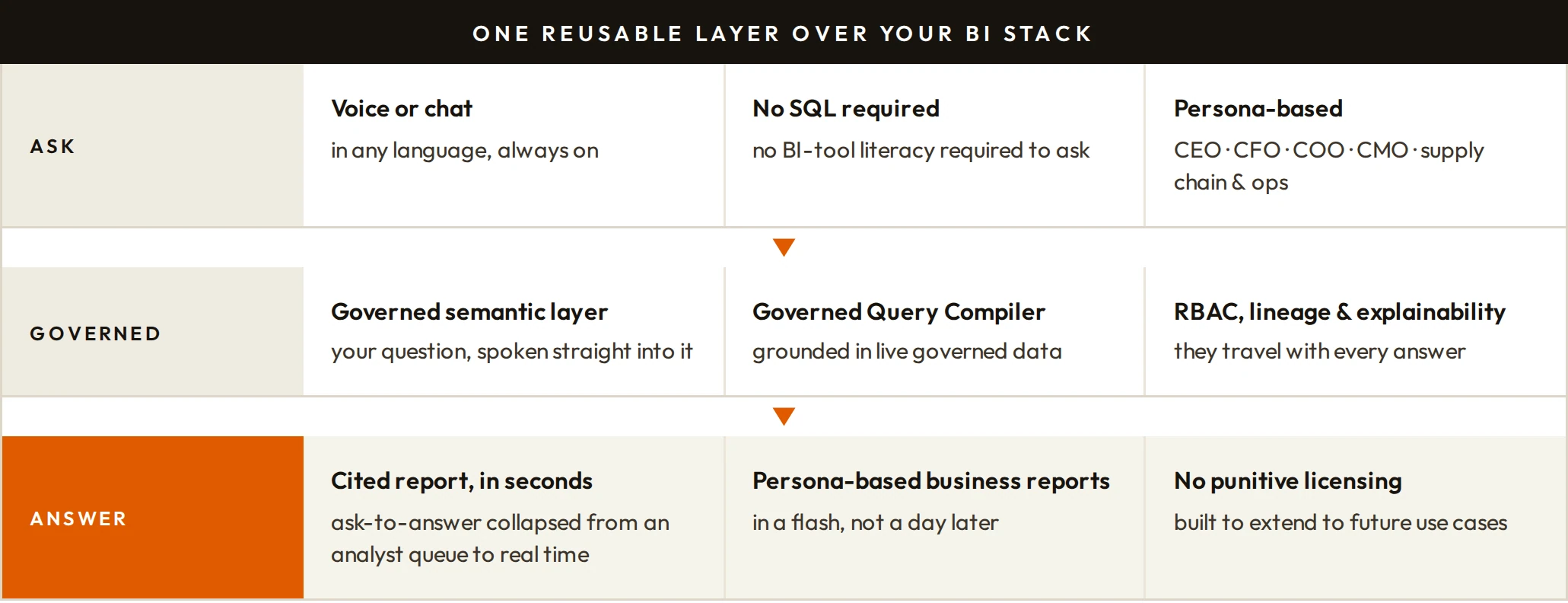
What you get
Outcomes you can hold us to.
Ask in natural language, by voice or chat, in any language
A cited, persona-based report back in seconds
Grounded in live governed data, every time
No SQL or BI-tool literacy required to ask
One reusable layer over your existing BI stack
No punitive per-seat licensing to put it in front of everyone
Built for
- CXOs & business heads
- CFOs & finance teams
- Sales & operations leaders
- Heads of data & analytics
Industries
- BFSI & fintech
- Retail & D2C
- Manufacturing
- Media & OTT
- Healthcare
Works with
- Your BI stack
- Semantic layer
- Text-to-SQL
- RBAC & lineage
Free demo and no-cost proof of concept
Connect it to one dataset and ask it your own questions.
One dataset or semantic model · no cost
The scope
- We connect InVocIQ to one governed dataset or semantic model
- You and your team ask the questions you actually put to your analysts
- You compare the answer, citation and speed against your current route
You provide
- Read access to one dataset or semantic model
- A handful of real questions your analysts are asked
- One business user and one data owner for a short session
You get
- A live voice and chat interface over that dataset
- Cited, persona-based answers to your own questions
- An honest assessment of coverage and where governance gaps sit
FAQ · Deployment, data and cost
What buyers ask before they commit.
Have a question that is not answered here?
01Do we have to replace our BI stack?
No. InVocIQ is a layer over the stack you already own, querying your governed semantic layer. Nothing is ripped out.
02How do we trust an AI-generated answer?
Every answer is cited and grounded in live governed data, so you can see what it was computed from. It does not free-associate over an unmanaged warehouse.
03Which languages does it support?
Voice or chat in any language — usually the difference between analytics that reaches head office and analytics that reaches the plant, branch or field team.
04Is licensing per seat?
No. It is one reusable layer rather than punitive per-seat licensing, which is what makes it viable to give everyone access instead of routing every question through the analyst queue.
05Where does it run?
As a layer over the BI stack you already own, inside your environment. It queries your governed semantic layer; it does not copy your warehouse.
06What can it change without us?
Nothing. It reads and answers. Your existing RBAC applies to every question, so a user can only be told what they were already permitted to see.
07Is our data used to train models?
No. Your questions and results serve you and nothing else.
08What does it cost after the first dataset?
The first dataset is free. Production is one reusable layer, deliberately not licensed per seat — so you can put it in front of everyone.
More solutions
10+ agentic solutions. One standard.

Spend & Sourcing Analytics
Agentic Sourcing Foundation
One governed spend foundation on your SAP data, with specialised AI agents for sourcing, contracts, finance and demand.
Explore
Performance Marketing
ApexAIQ
35 agents across seven crews work your Google and Meta accounts in parallel, 24/7.
Explore
Data Privacy & Compliance
DPDP-AID
DPDP Act compliance through true discovery — code, schemas and legacy data parsed for real lineage.
ExploreNext step
Ask your own data, out loud.
Book a free demo of InVocIQ, or scope a no-cost proof of concept (PoC) on your own data. A senior engineer replies within one business day.