
DPDP-AID · Data Privacy & Compliance Consent is a data structure, not a checkbox.
- True discovery
- Continuous compliance
- DPDP Act 2023
A true-discovery engine that parses your code, schemas, endpoints and unstructured artefacts for real data lineage, processing purpose and DPDP violations — down to the individual data principal.
- Up to ₹250 crore
- Maximum penalty per breach
- 13 May 2027
- Full compliance deadline, phased in since November 2025
- B2C · B2B · B2B2C
- Every model in scope: consent, processor and intermediary chains
Why DPDP-AID
Two common approaches to DPDP. One gap remains.
Approach A
Consent management SaaS
A licensed platform to capture, store and manage consent from now on. It cannot see what your existing systems have already processed without consent.
Approach B
Audit or consulting partner
A gap assessment built on interviews and self-reported inventories. A snapshot in time, not a living system of record.
humaineeti
True discovery
Parses your actual code, schemas, legacy data and artefacts for data lineage — continuously, down to the individual data principal and processing purpose.
How it works
How DPDP-AID runs.
/ 01
Discover
Every line of code, schema, endpoint and unstructured artefact, parsed.
/ 02
Map
Source-of-truth lineage and processing purpose, down to the data principal.
/ 03
Generate
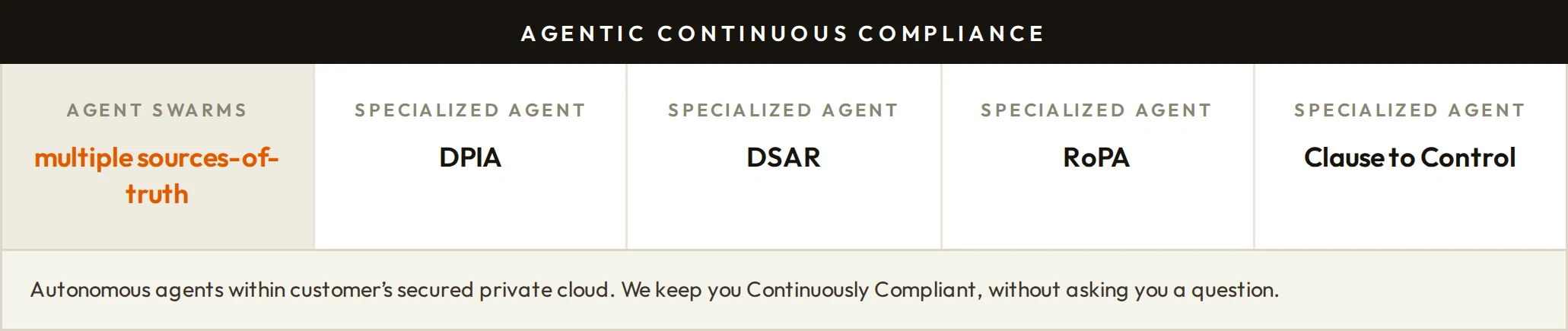
Data protection impact assessments (DPIA), the record of processing activities (ROPA), data subject access request (DSAR) responses and clause-to-control, generated autonomously.
/ 04
Monitor
Continuous, not a snapshot — violations surfaced as they appear.
See it on your own data
Watch DPDP-AID work on a real use case, in a 30-minute live demo.
Free. Then a scoped proof of concept at no cost, before you commit.
At a glance
DPDP-AID against the usual approaches.
Sees legacy data already collected
- Consent SaaS
- —
- Audit / GRC
- —
- DPDP-AID
- ✓
Traces cross-border transfers at source
- Consent SaaS
- —
- Audit / GRC
- —
- DPDP-AID
- ✓
Maps every PII field to a discovered processing activity
- Consent SaaS
- —
- Audit / GRC
- —
- DPDP-AID
- ✓
Continuous, not a one-time snapshot
- Consent SaaS
- ✓
- Audit / GRC
- —
- DPDP-AID
- ✓
Autonomous DPIA, ROPA register, DSAR response and clause-to-control
- Consent SaaS
- —
- Audit / GRC
- —
- DPDP-AID
- ✓
Autonomous agents inside your own secured private cloud
- Consent SaaS
- —
- Audit / GRC
- —
- DPDP-AID
- ✓
✓ delivered · — not addressed.
Inside the solution
DPDP-AID, drawn out.

What you get
Outcomes you can hold us to.
True discovery across code, schemas, endpoints and unstructured artefacts
Source-of-truth data lineage, down to the individual data principal
Every PII field mapped to a discovered processing purpose
Cross-border transfers traced at source, not from a questionnaire
Autonomous DPIA, ROPA register, DSAR response and clause-to-control
Agents that run inside your own secured private cloud
Built for
- DPOs & privacy leads
- CISOs & security teams
- General counsel & compliance
- CTOs & engineering leaders
Industries
- BFSI & fintech
- Retail & D2C
- Manufacturing
- Media & OTT
- Healthcare
- PSU & government
Works with
- Code repos
- DB schemas
- API endpoints
- Unstructured stores
- Private cloud
Free demo and no-cost proof of concept
Point true discovery at one application and see what is actually there.
One application or repository · no cost · in your environment
The scope
- We run true discovery on one application, repository or schema you choose
- Agents deploy inside your own secured environment, so data never leaves
- You see discovered lineage and purpose, not a self-reported inventory
You provide
- One application, repository or database schema in scope
- A private-cloud or VPC environment for the agents to run in
- A privacy or engineering contact for a short scoping call
You get
- A discovered PII inventory with lineage and processing purpose
- A list of DPDP sections and rules currently at risk
- A sample ROPA entry and DPIA, generated autonomously from real data
FAQ · Deployment, data and cost
What buyers ask before they commit.
Have a question that is not answered here?
01We already bought a consent management platform. Why do we need this?
A consent management platform (CMP) manages consent from now on. It has no view of what your existing systems have already collected and processed without consent — which is where the penalty exposure sits. DPDP-AID discovers that, and the two work together.
02Does our data leave our environment?
No. The agents are deployed inside your own secured private cloud. Discovery runs where your data already lives.
03How is this different from an audit or gap assessment?
An audit relies on interviews and self-reported inventories — a snapshot. DPDP-AID parses your actual code, schemas, endpoints and legacy data continuously, so the register stays accurate after the auditor leaves.
04What is the compliance deadline?
The DPDP Rules 2025 have been phasing in since November 2025, with full compliance required by 13 May 2027. Penalties reach ₹250 crore per breach, which is why discovering legacy processing matters now.
05Where does it run?
Inside your own secured private cloud. The agents deploy in your environment, so the code, schemas and personal data they parse never leave it.
06What can it change without us?
Nothing in your systems. It discovers, maps and drafts the compliance artefacts — DPIA, ROPA, DSAR responses and clause-to-control — for your DPO to review and own.
07Is our data used to train models?
No. Nothing discovered in your environment leaves it — that is the point of deploying inside your boundary.
08What does it cost after discovery?
Discovery on one application is free. Production is priced against the estate in scope — scoped on the call.
More solutions
10+ agentic solutions. One standard.

Spend & Sourcing Analytics
Agentic Sourcing Foundation
One governed spend foundation on your SAP data, with specialised AI agents for sourcing, contracts, finance and demand.
Explore
Performance Marketing
ApexAIQ
35 agents across seven crews work your Google and Meta accounts in parallel, 24/7.
Explore
EHS Management
IntelliEHS
Incidents, BBS, audits, occupational health and CAPA in one no-code, auditable system of record.
ExploreNext step
Get ahead of the 13 May 2027 deadline.
Book a free demo of DPDP-AID, or scope a no-cost proof of concept (PoC) on your own data. A senior engineer replies within one business day.